
The Frankenstein Tech Stack
Why Most AI Transformations Fail at the Foundation

Once leaders decide they need an AI strategy, the rush begins.
Vendor demos. Pilot programs. Roadmaps built under quiet pressure from the board. What rarely happens in that moment is a pause to examine what the organization is actually built on.
AI does not fail because companies lack ambition or access to tools. It fails because it is introduced into systems that have never fully reconciled their foundations, technically, operationally, or humanly. Before deciding what AI to adopt, leaders have to understand what kind of structure they are asking it to operate within.
AI transformation does not start with tools. It starts with foundations, people and systems, and an honest assessment of whether they can actually carry what is being added.
According to Deloitte’s State of AI in the Enterprise 2026 report, only about a quarter of organizations have moved a significant portion of AI projects into production, and just over a third report using AI in ways that deeply transform their business. In other words, while experimentation is widespread, most companies are still early in scaling AI across the enterprise, constrained not by tools, but by fragmented systems, unclear ownership, and limited organizational readiness.
Nowhere is that more visible than in a company’s tech stack.
The Two Patterns I See in Almost Every Organization
Across industries and geographies, most companies fall into one of two architectural patterns. They look different on the surface, but they share a critical flaw.
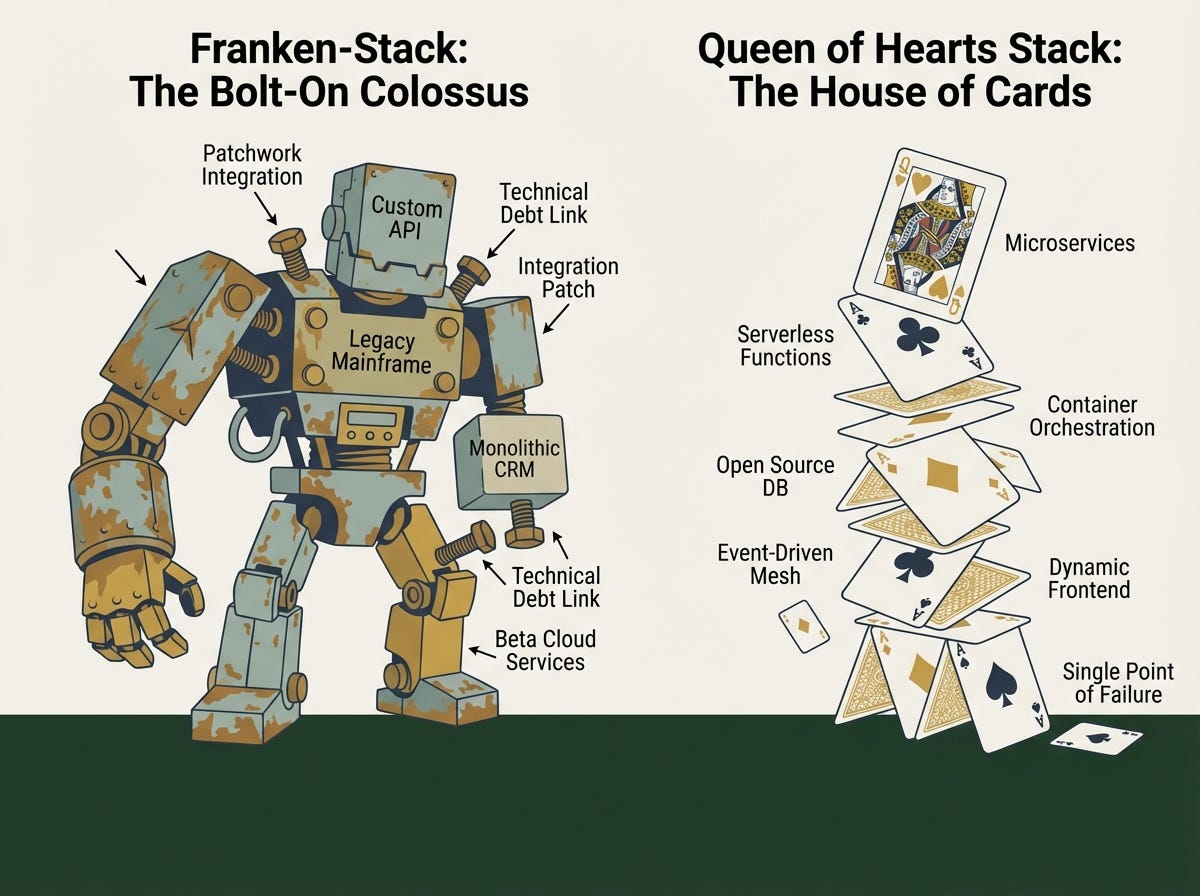
The Frankenstein Tech Stack
The Frankenstein stack belongs to the mature organization, the one that has grown over decades through acquisitions, expansions, and restructurings. These companies did not move recklessly. They moved pragmatically.
A company is acquired. Instead of fully migrating its systems, leadership bolts them on. The acquired team keeps its tools, platforms, and processes because integration is deferred to a later date. Over time, those decisions compound.
Each system works in isolation. Very few work together.
From the outside, the organization looks stable. From the inside, people rely on tribal knowledge to move data from one place to another. Governance lives in slide decks. Integration exists in theory.
Then leadership declares, “We’re ready for AI.”
What they do not realize is that they are asking a system built from mismatched parts, never designed to function as a single organism, to suddenly behave like one.
The Queen of Hearts Stack
The Queen of Hearts stack belongs to the fast-moving organization: startups, scale-ups, unicorns in hypergrowth. Speed is survival. Tools are chosen for immediacy, not longevity. Decisions are optimized for now.
Operating systems change twice in a year. Thousands of employees are migrated mid-sprint. Teams tell themselves they will stabilize the foundation after the next milestone, the next funding round, the next launch.
The difference here is not neglect. It is sequencing. The foundation is not broken. It was never fully built. From the outside, everything looks impressive. From the inside, everyone knows how fragile it is.
Why Both Patterns Break Under AI
These two stacks look like opposites. One moves slowly. The other moves at breakneck speed. Both fail for the same reason: architectural debt.
The Frankenstein stack accumulated it over time. The Queen of Hearts stack deferred it entirely. AI is intolerant of both.
Unlike previous waves of technology, AI does not sit neatly on top of existing systems. It depends on clean data, clear ownership, integrated workflows, and consistent decision logic. When those do not exist, AI does not create efficiency. It amplifies confusion.
Many leaders misdiagnose this as a tooling problem. In reality, AI is exposing deeper structural ones.
What AI Exposes First
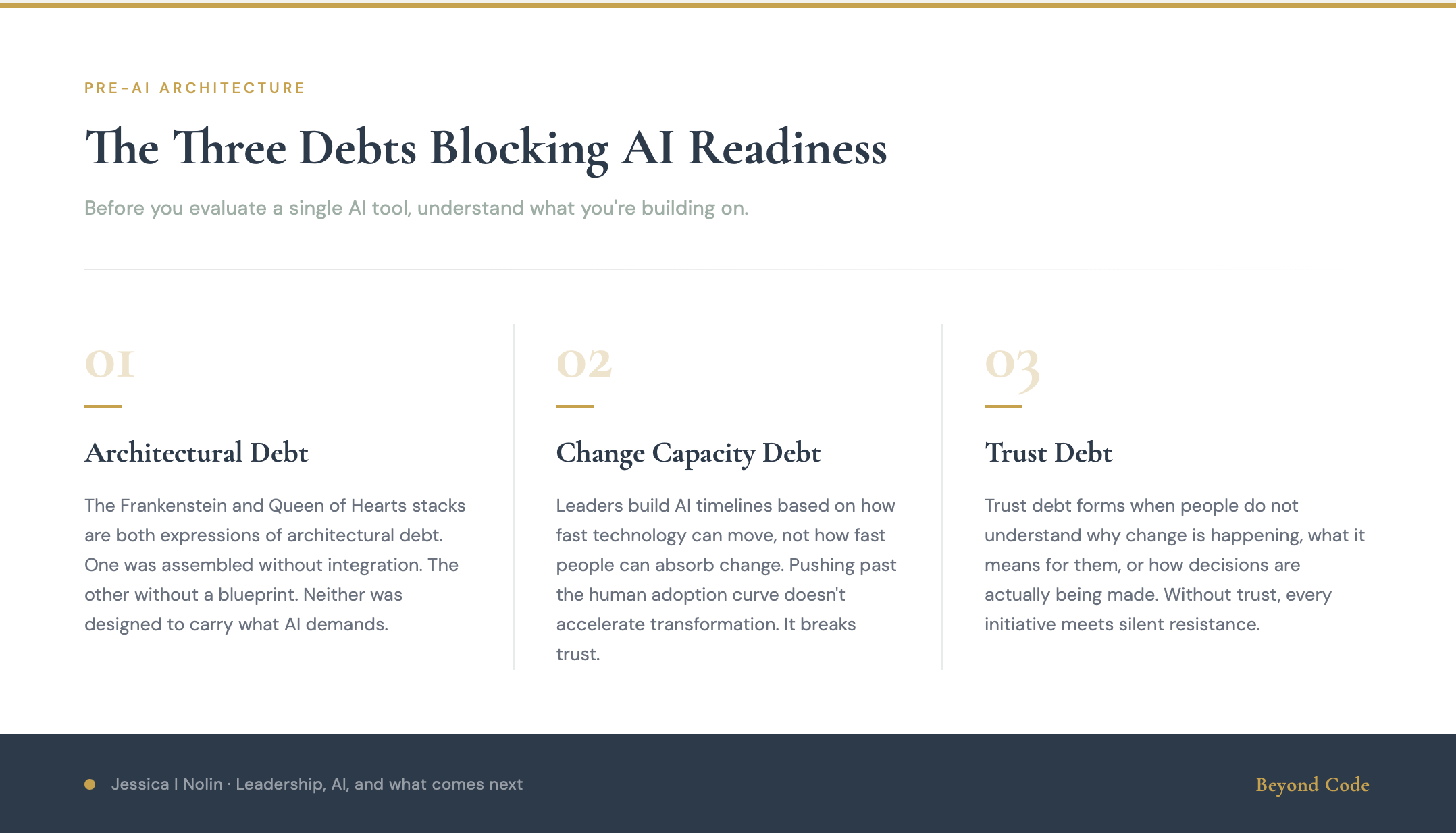
In my work across legacy organizations and high-growth companies, I have learned this: AI does not create dysfunction. It reveals it. And it does so across three layers that are often misunderstood as one.
1. Architectural Debt
This is the most visible layer.
Fragmented systems. Broken migrations. Data that exists in theory but not in practice. When no one can clearly articulate where data lives, who owns it, or how it moves, AI initiatives stall before they scale.
The Frankenstein and Queen of Hearts stacks are both expressions of architectural debt. One accumulated. The other deferred.
2. Change Capacity Debt
This is where most transformation plans quietly collapse.
Leaders build AI timelines based on how fast technology can move, not how fast people can absorb change. In reality, most timelines are driven by board pressure or quarterly targets.
People do not resist change because they are irrational. They resist it because they are saturated. When transformation outpaces integration, trust erodes. AI introduced into that gap widens it.
3. Trust Debt
This is the least discussed and most destabilizing layer.
When employees hear “audit,” “optimization,” or “clean up,” they hear layoffs. When leaders avoid naming that fear directly, it fills the vacuum.
Trust debt forms when people do not understand why change is happening, what it means for them, or how decisions are actually being made. AI accelerates this debt because it touches identity, not just workflows.
What Must Be True Before You Touch AI
Before evaluating a single vendor or platform, leaders need to ensure a few things are true. Not aspirational. Not someday. True now.
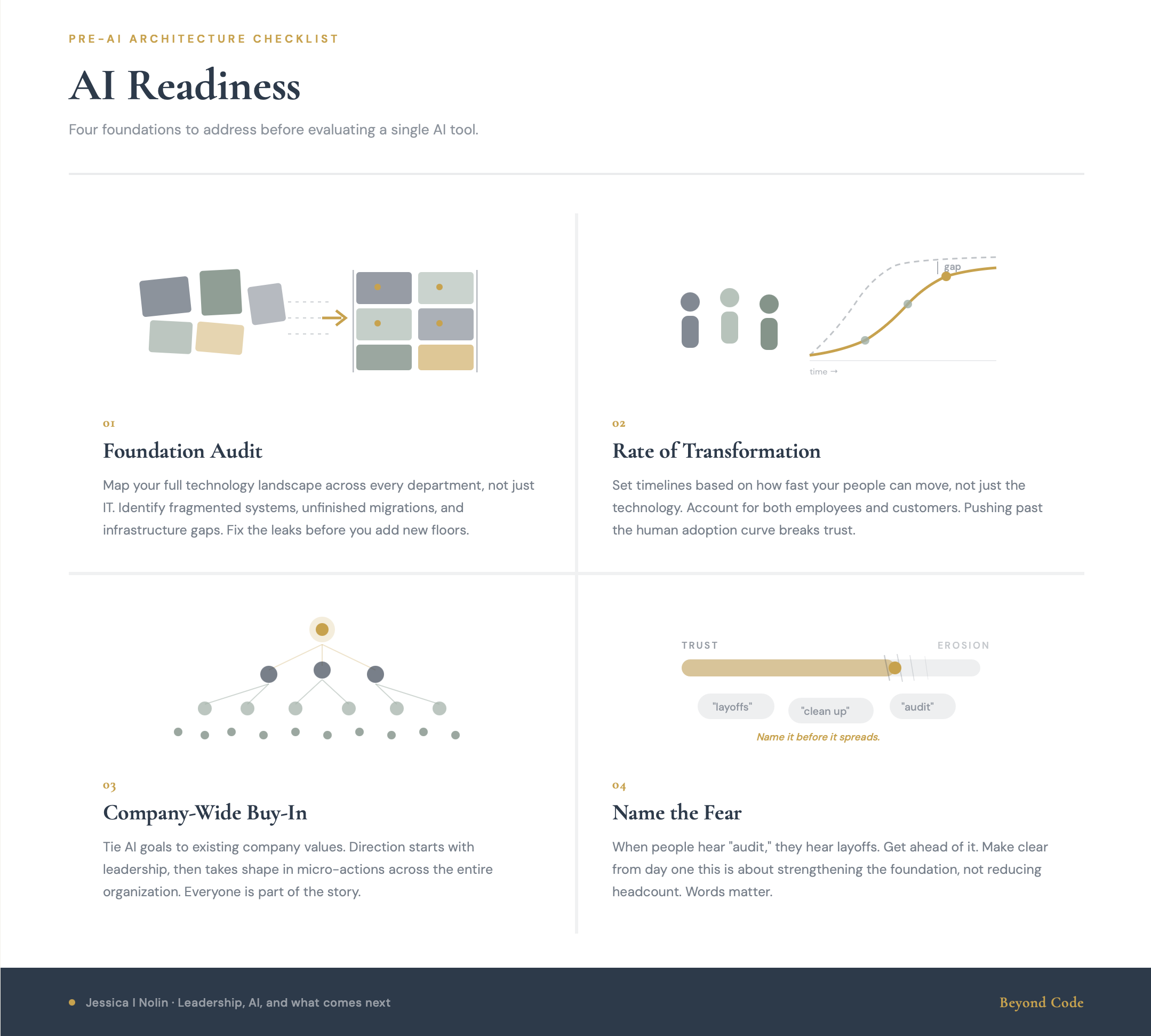
1. You have audited your foundation honestly.
Most organizations do not have a current, end-to-end map of their technology landscape. Systems live across cloud providers, on-prem servers, and legacy platforms built by teams that no longer exist.
An AI readiness assessment is not a vendor pitch. It is a full audit of what exists, who uses it, and what condition it is in across every department, not just IT.
Few things are more expensive than discovering halfway through an AI implementation that the data you planned to use is outdated, inaccessible, or unusable.
2. You understand your rate of transformation for people and systems.
Transformation fails when leaders assume people can move at machine speed.
Employees adopt new tools internally. Customers experience the impact externally. Optimizing for one without accounting for the other creates friction that AI magnifies.
Research in organizational change consistently shows that pushing beyond human adoption curves does not accelerate transformation. It breaks trust.
3. You have company-wide buy-in, not just executive alignment.
AI transformation does not scale when it is owned by a handful of people in a room. Like culture, it takes shape through micro-decisions across the organization.
The most effective leaders tie AI goals to an existing company value, something the organization already believes in. Over time, that value becomes operationalized through tools, workflows, and incentives.
People do not engage because they are told to. They engage because they understand how they fit into something larger than themselves.
4. You have named the fear before it spreads.
Words matter when people are already nervous.
Make it explicit from day one that this work is about strengthening the foundation, not reducing headcount. Be disciplined about language. Remove phrases like “clean up” from leadership vocabulary.
If fear goes unaddressed, it will be answered by rumor. Once trust erodes, no amount of tooling will fix it.
Your Monday Morning Move
Before your next AI strategy conversation, pause and ask:
Do we actually have a shared, current view of what our systems and data look like today?
Are we moving at the speed of technology or at the speed our people can realistically absorb?
What fear about AI have we not named out loud yet?
If we added AI tomorrow, what existing cracks would it immediately widen?
Do not answer these in a deck. Answer them in conversation.
The Real Starting Point
AI readiness is not a checklist item. It is a reckoning.
It asks leaders to confront past decisions: what was deferred, what was patched, and what was never fully integrated. It also asks them to acknowledge the human cost of moving faster than people can follow.
The companies that scale AI successfully are not the ones with the most advanced tools. They are the ones that took the time to reconcile their foundations before building higher.
You cannot build a legacy on a stack of cards. And you cannot ask a stitched-together system to carry a technology designed for coherence.
In the pieces that follow, I will break down each of these debts, architectural, change capacity, and trust. I will explore where they come from, how they compound, and what leaders must confront before AI makes the cost unavoidable.
Because the question is not whether AI will transform your organization. It is whether your organization is structurally ready to survive the transformation.
Happy mapping,
Jessica | Leadership, AI, and what comes next